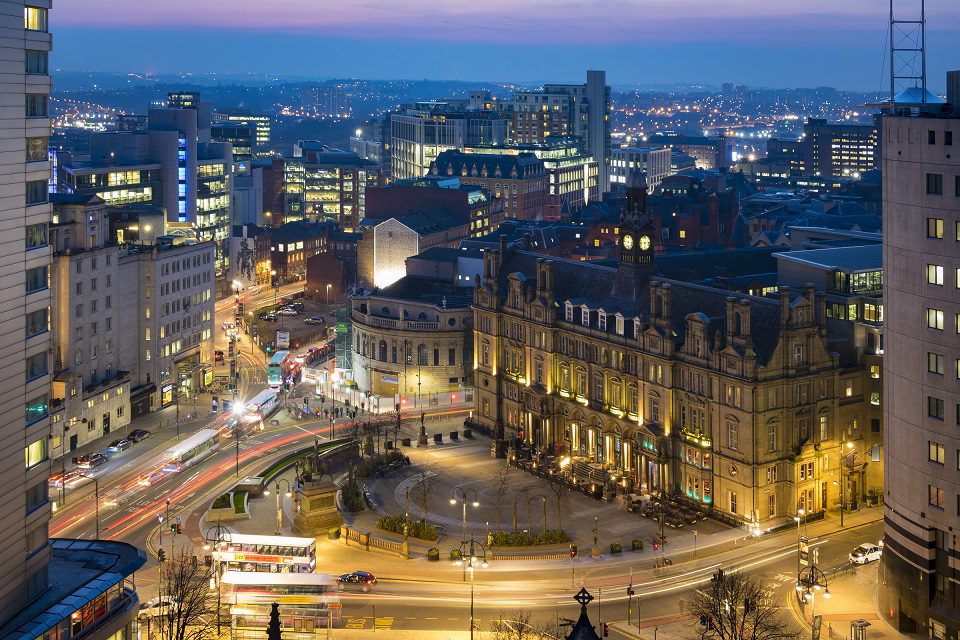

Every city has its iconic squares and plazas beloved by locals and visitors alike. Leeds is no exception, boasting some remarkable architectural landmarks. Today, we explore Leeds’ City Square, situated north of Leeds Railway Station. This triangular square is where six streets converge: Infirmary Street, Park Row, Boar Lane, Bishopsgate Street, Quebec Street, and Wellington Street. Learn more about the history of City Square on ileeds.info.
Origins of City Square
In 1893, city officials proposed creating a square in front of the station. This plan involved demolishing the coloured cloth halls and the Quebec House to create an open space initially considered for naming after engineer John Smeaton. However, the city council opted for the more general name, City Square, as Leeds was evolving into a modern urban hub.
In 1896, a new General Post Office was constructed on the square. Designed by architect William Bakewell, the square took on the appearance of a slice of Italy, complete with statues and trees.
During World War II, City Square was bombed and sustained significant damage. A bomb shelter on the square was also affected during air raids.
Although buses and taxis once traversed the square, one side was closed to traffic during a 2003 renovation. The revamped square now features statues, fountains, and street furniture.
Statues of Famous Figures on City Square
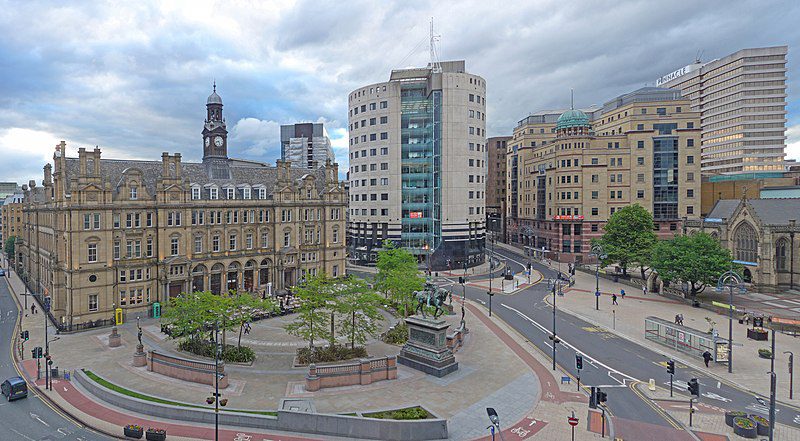
City Square in Leeds is adorned with numerous bronze statues, all over two metres tall and listed as Grade II historic monuments. Some notable statues include:
- The Black Prince: This prominent equestrian statue of Edward, designed by Thomas Brock, dominates the square. Despite Edward having no direct connection to Leeds, his depiction stands on a pedestal adorned with relief panels illustrating his victories. The statue was completed after seven years of work and cast in Belgium. It was unveiled in 1903, funded by Colonel Thomas Walter Harding.
- James Watt: The statue of the renowned engineer also has no direct link to Leeds. However, Watt’s inventions significantly influenced the city’s industrial growth. This statue was unveiled in 1903.
- John Harrison: A statue of the famous Leeds philanthropist and cloth merchant is prominently displayed. Harrison, a key figure in the city’s history, made substantial contributions to Leeds, including funding the completion of a hospital building for the poor, constructing a new grammar school building, and founding St. John’s Church.
- Dr Walter Hook: Once the vicar of Leeds, Hook played a pivotal role in the city’s religious and educational development. He spearheaded the reconstruction of the parish church, now Leeds Cathedral, and promoted the construction of 30 schools. His statue was unveiled in 1902 as a gift from Colonel Harding.
- Joseph Priestley: This statue commemorates the famous chemist and theologian who lived in Leeds. Priestley, known for his groundbreaking scientific discoveries and extensive writings, conducted experiments across various disciplines.
Architectural Landmarks Around City Square
In addition to statues, City Square is surrounded by notable architectural landmarks:
- Queens Hotel: Built in 1937, this Grade II-listed Art Deco building replaced the original railway hotel from 1863. The new hotel’s interior design was crafted by William Curtis Green, and its construction required two million bricks and 40,000 cubic feet of Portland stone.
- Mill Hill Chapel: This Unitarian church traces its origins to 1674, with one of its founders being the father of historian Ralph Thoresby. From 1767 to 1773, Joseph Priestley served as its minister.
- Majestic: Originally a cinema built in the early 1920s, it was later repurposed as a bingo hall and then a nightclub. In 1993, the building was listed as a Grade II historic site. After being damaged by fire in 2014, it was restored and now houses offices.
City Square in Leeds is undoubtedly a jewel of the city, embodying its rich history and architectural heritage. We hope this material has been informative, offering you insights into the city’s fascinating past. Do you often visit City Square? Share your experiences with us on social media!