

Sports hold an important place in the life of Leeds. Many well-known athletes began their sporting careers here, and the city is home to numerous sports complexes and stadiums. Today, we will discuss an indoor arena – Leeds Arena. Learn more about its history, construction, and further development on ileeds.info.
The Arena that Residents Demanded
Leeds Arena is certainly not the oldest structure in the city. Its history begins in the 21st century. It all started when Leeds became the largest city in the United Kingdom without a large indoor venue for music and sporting events. Authorities were so focused on developing the city as an economic and financial hub that they seemingly forgot about sports and culture. Until 1989, the Royal Hall was used for hosting concerts, but the building was eventually demolished, leaving Leeds without a spacious concert venue.
The residents of Leeds began demanding the construction of a new arena, prompting the formation of a working group. A large-scale campaign called “Leeds Needs an Arena” was launched. It gained support from local showbiz stars, businesses, and the residents themselves. The campaign was heavily promoted in the media and social networks, gaining significant popularity.
The Competition and Construction of Leeds Arena
The widespread popularity of the project in the media and social networks led to competitions to find the operator and developer for the arena. In 2008, SMG was chosen as the future operator, as the company already managed arenas in Newcastle, Belfast, and Manchester, among others. The chosen location for the new arena was Claypit Lane.
Before construction even began, experts predicted that Leeds Arena would generate over £25 million for the city and create 300 jobs. The cost of building the new facility was estimated at £80 million.
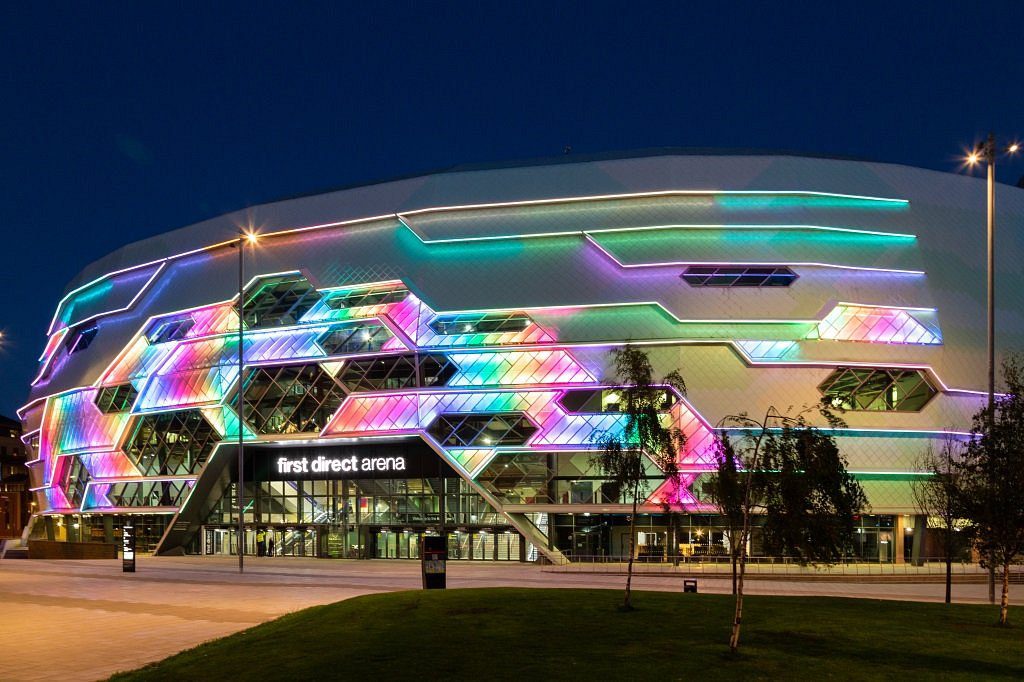
In 2011, construction of the arena began, lasting over two years. It is worth noting that Leeds Arena was built in the shape of a super-theatre. The project developers promised spectators “perfect sightlines” from every seat. For comparison, the longest distance from the stage in Leeds Arena is 68 meters, whereas traditional arenas typically offer distances of 95–110 meters.
An important feature of the Leeds Arena is its flexible design, allowing it to host a variety of events – from concerts to sports competitions. Additionally, the front of the building can change colors or patterns at night, depending on the event being held at the arena.
Leeds Arena was officially opened on September 4, 2013, with Sir Elton John performing in front of a packed audience. However, the first concert at the arena actually took place a few months earlier. In July 2013, Bruce Springsteen held the inaugural concert at the newly built Leeds venue. It is noteworthy that within a year, Leeds Arena was recognized as the “Best New Venue in the World” by the Stadium Business Awards.
Leeds Arena has hosted many concerts, shows, and festivals. Sports events have also been a significant part of its schedule. Some notable examples include:
- WWE Live
- The 2014 Premier League Darts Tournament
- The Tour de France Grand Départ team presentation
- The 2015 Premier League Darts Tournament
Sports are an essential part of society, and for a large city, having a sports arena is a standard necessity. We live in an era where people place great importance on leisure, making efforts to attend concerts, shows, festivals, sports matches, and competitions.
This is the story of the creation of Leeds Arena. From an idea born out of the residents’ demands to its status as a world-class venue, Leeds Arena has become a key cultural and sporting hub for the city.
We hope this article was informative and gave you more insights into your home city.